

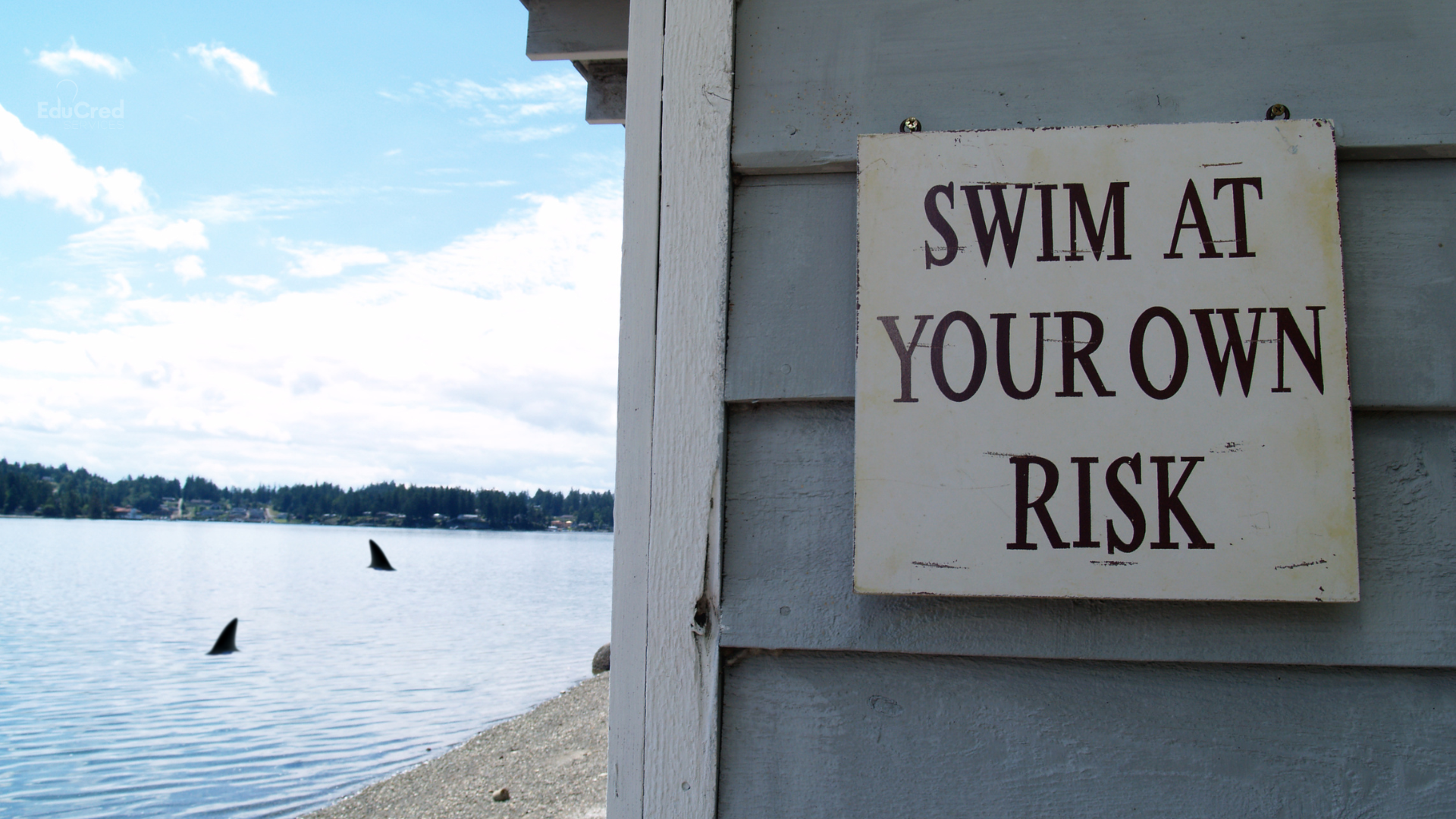
This coming weekend begins the hallowed and solemn occasion observed the world over. That’s right, friends: it’s Shark Week. As a lifelong, self-declared “beach person,” I’ve always been a little puzzled by people’s fear of the ocean. Thalassophobia is a concept mostly lost on me. The ocean is where the waves are! And yet, I must confess: every year, after my annual viewing of Shark Week, even I wade into the water with elevated trepidation. Suddenly every shadow is suspicious. Every piece of drifting kelp is a dorsal fin. Was that a fish that just brushed my leg, or am I about to add a particularly grisly chapter to my autobiography?
Now, every good consultant loves a statistic, and, statistically speaking, you are far more likely to be injured by a vending machine than a great white. This isn’t to say that you can’t be scared of sharks (they’re fast, quiet, and chompy); if you see one, get out of the water. Where we run into problems, though, is when we spend all day scanning the waves and don’t put on sunblock. In a typical year, there are around 60–70 unprovoked shark attacks worldwide across all seven-ish billion of us. Meanwhile, roughly one in five Americans will develop skin cancer in their lifetime. Only one of these things gets a dedicated week of programming and a legendary John Williams score, but it’s not the one that’s statistically coming for you. The danger we fear most is dramatic, visible, sharp-toothed, and vanishingly rare. The danger that is most likely to get us is quiet, cumulative, and completely preventable with about thirty seconds of effort before we get in the water.
Which brings me, as all things eventually do on this blog, to higher education compliance. Institutional leaders lose sleep over the shark-shaped disasters like a surprise show cause, a front-page scandal, or their state regulators shuttering their doors. Meanwhile, the sunburn is already underway (an expired authorization here, a contradictory policy there), quietly accumulating damage that won’t hurt until it really hurts.
As higher education accreditation consultants, our job isn’t to tell you that the scary things don’t exist. It’s to tell you which risks are actually likely, so you can spend your energy (and your budget) accordingly. We’re the friend on the beach towel next to you saying, “For sure, keep an eye on the water, but you’re turning pink.” That’s where we come in. As higher education accreditation consultants, part of our job is helping institutions worry about the right things. So, in honor of the season, let’s look at some worries we hear all the time (especially from new institutions), and what you should be worried about instead.
Once we’re accredited, enrollments are going to EXPLODE.
Technically this one is a hope, not a fear, but it functions like a fear, because entire financial plans are built on it. The milestone (licensure, accreditation, that one big employer partnership) becomes the moment when everything changes: the floodgates open, the students pour in, and the spreadsheet’s optimistic financial projection tab finally comes true.
Accreditation removes a barrier. It does not create demand. Nobody enrolls at an institution because it’s accredited; they enroll because the program is worth wanting, and accreditation lets them say yes. Evaluators know this, which is why they’re skeptical of budgets that depend on enrollment miracles. Accreditors don’t want to be in the business of accrediting institutions that may not exist in five years.
What you should be worried about: Whether your institution actually works at its current enrollment. That means monitoring every aspect of your operations through your institutional effectiveness plan (budgets, student achievement, marketing, technology, support services) and demonstrating that all of it is consistently improving. Is your budget sustainable with the students you have now? Are your current students achieving the outcomes you said they would? Is your marketing reaching the right people, and can you prove it? An institution that runs well at 50 students and can show a documented trail of improvement is infinitely more credible (to accreditors and prospective students) than one waiting for a rush of 500 students to fix everything.
What if our site visit team hates us?
We usually hear this one in a hushed tone, like saying it louder might summon them. The fear of a hostile evaluator, equipped with a red pen and a personal vendetta against your institution, looms large in the imagination.
Here’s the reality: site visit teams are your peers. They’re higher ed professionals with a checklist and a schedule, not villains circling your campus with ominous cello music. Visits don’t go sideways because reviewers are mean. They go sideways because a reviewer asks a staff member how admissions decisions get made and receives an answer that contradicts the self-study or doesn’t meet an accreditation standard. The team isn’t the threat, but an inconsistent or undocumented response is.
What you should be worried about: Whether your documents describe anything real. If your policies were written to impress evaluators rather than to reflect how you truly operate, no amount of reviewer goodwill will save you, and even the friendliest team will, to borrow a phrase, “smell the blood in the water.” Audit your practice against your paper before someone else does. (This, incidentally, is exactly what a mock site visit is for.)
We’re too unique for accreditation, the process is going to change who we are.
This fear comes up constantly, and it’s most intense at mission-driven and innovative institutions (our favorite kind!). Their worry goes something like this: accreditation is a standardization machine, our program is unlike anything else out there, and the process is going to sand off everything that makes us us until we’re just another interchangeable institution. These institutions often loathe the idea of program comparisons, particularly, and brace themselves to defend their identity against a system they assume is hostile to it. “There’s no point comparing us to anyone, we’re so different.”
Accreditors are not trying to make you generic. We genuinely love it when an institution’s processes look different from everyone else’s. It usually means their operations are authentic and mission-driven instead of copied from a template. Accreditation standards describe what an institution must accomplish, not how. Your job isn’t to become like everyone else, but you do need to make the case that your unique way of operating still meets the intent of each standard. That case needs to include context, data, and a clear narrative connecting your distinctive practices to the outcomes the standards exist to protect. “We’re different” isn’t a defense. “We’re different, and here’s exactly how our approach achieves what this standard requires” absolutely is.
And about those dreaded program comparisons you’re tempted to skip: do them anyway. Even when there’s no direct 1:1 match, comparing your program to the broader landscape (credit hours, learning outcomes, faculty credentials, gen ed requirements) is a critical checkpoint. It’s how you confirm your innovative program is still recognizably a higher education program. Because there’s a hard question every “totally unlike anything else” curriculum needs to answer: if your bachelor’s degree shares no DNA with any other bachelor’s degree, is it actually compliant? Innovation lives within the basic requirements of the credential, not instead of them. The comparison doesn’t alter your identity; it protects your credential.
What you should be worried about: Whether you can make the case (with context and data, not just conviction) that your unique operations meet the intent of the standards. This, incidentally, is what we do best. Our job isn’t to make you look like every other institution; it’s to protect your identity while building the evidence and narrative that support your assertion that you meet the standard. Get that right, and you will come out the other side of accreditation with validation that your different way of doing things works.
Enjoy Shark Week. Wear Sunblock.
Please revel in every slow-motion breach and ominous note from the string section. But when it comes to your institution, remember that the shark-shaped problems are almost never the ones that get you. The policies that don’t match practices, the state you forgot and enrolled a student in, the data nobody collected, the shortcut taken under pressure—those might not hurt today. But all of it hurts eventually. And every bit of it is preventable.
And, to extend this metaphor to its absolute limit, we’re here on the next beach towel, and also, we’re dermatologists (I said “to its absolute limit”). We’ll help you sort your real risks from your imagined ones, fix what needs fixing, and save the adrenaline for the television (or your next vacation), where it belongs.
Happy Shark Week! Watch the water. But seriously: reapply.